Data Team Discovery
iGaming Suite For BI And Data Teams
BI and data-team entry point for synthetic casino datasets, data dictionaries, accepted operator-data batches, reporting proof, reconciliation and downstream analytics contracts.
Audience
BI analysts, data engineers, analytics leads, CRM data teams, QA teams and external vendor evaluators.
Proof
Horus Lab produces bounded data/proof packages, Horus Intelligence consumes accepted operator-data batches and Viper tracks experiment and CRM evidence objects.
Limits
Public pages expose contracts and methodology, not private row-level customer, player, operator or affiliate data.
Product evidence
Visible product proof for humans and agents
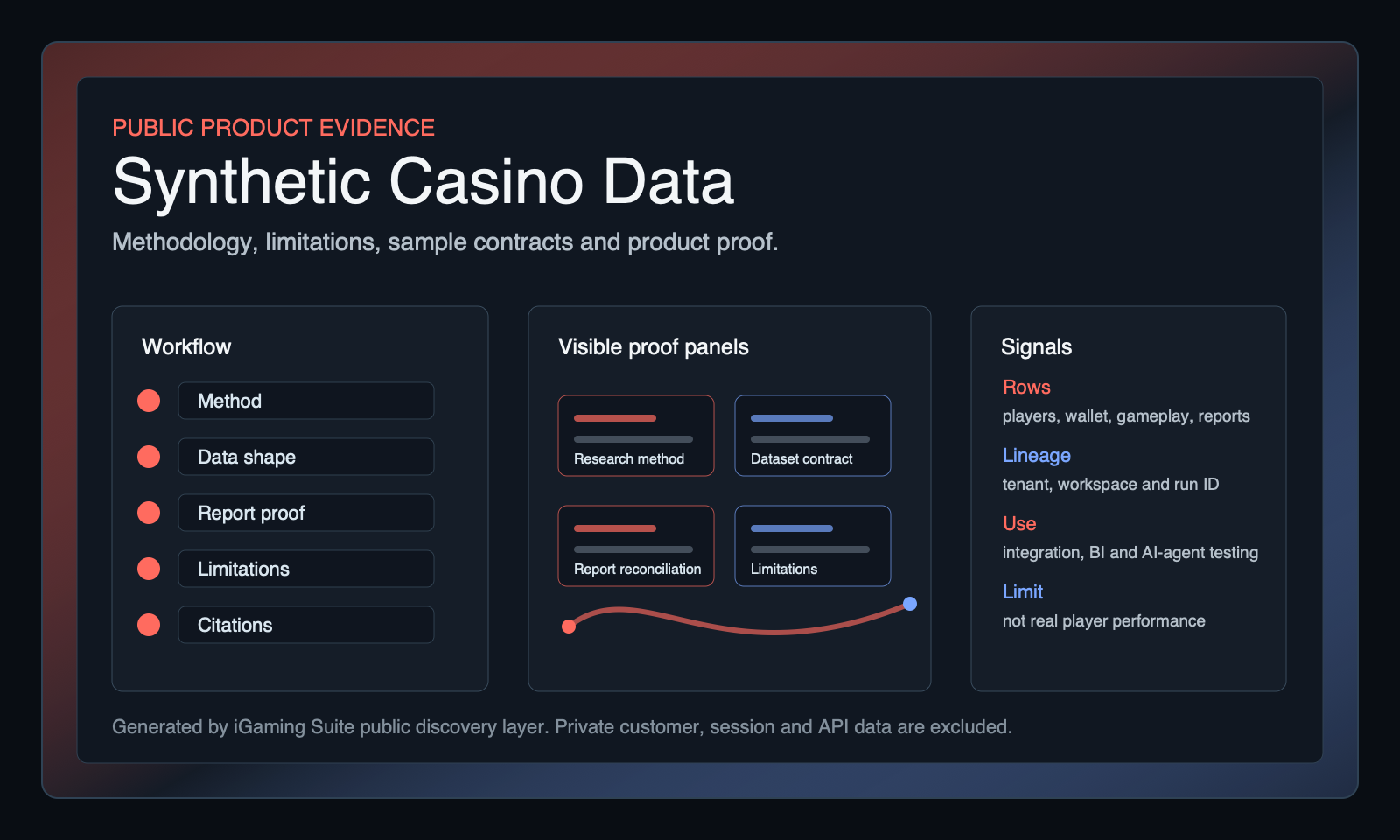
Visible proof table
| Signal | Visible proof on this page | Discovery value |
|---|---|---|
| Audience | BI analysts, data engineers, analytics leads, CRM data teams, QA teams and external vendor evaluators. | Connects the page to a real professional audience instead of generic iGaming traffic. |
| Proof | Horus Lab produces bounded data/proof packages, Horus Intelligence consumes accepted operator-data batches and Viper tracks experiment and CRM evidence objects. | Gives crawlers, AI retrieval systems and readers a concrete product claim to understand. |
| Limits | Public pages expose contracts and methodology, not private row-level customer, player, operator or affiliate data. | Builds trust by stating what the public page does not expose or prove. |
| Public contract signals | operator_data_delivery_batch.v1 | horus_lab_developer_run_data.v1 | horus_lab_developer_run_proof.v1 | viper_lift_outcomes | Makes product APIs, data objects and entity names easy to parse and cite. |
What this page makes discoverable
- Data dictionaries and canonical terms
- Run lineage and cleanup proof
- Accepted-batch reporting boundary
- Experiment and CRM evidence objects
Public contract signals
These names help humans, search engines and AI retrieval systems understand the product boundary without exposing private workspace data.
- operator_data_delivery_batch.v1
- horus_lab_developer_run_data.v1
- horus_lab_developer_run_proof.v1
- viper_lift_outcomes
Search intent map
What professionals are likely to search
| Search language | Likely reader | Page answer |
|---|---|---|
| iGaming data team synthetic casino data | BI analysts and data engineers | Connects Horus Lab run data to reporting proof, data dictionaries and accepted-batch boundaries. |
| casino reporting data dictionary | Analytics and integration teams | Points teams to glossary terms, Products Report, Players Report and operator-data batch language. |
| VIP CRM experiment data model | CRM data teams and Viper evaluators | Explains that Viper lift outcomes and treatment/control records must stay tied to explicit evidence objects. |
Discovery rationale
What data teams need to validate
BI and data teams should be able to inspect whether generated records, report outputs and experiment evidence describe the same journey. This page maps their search intent to the product surfaces that own those contracts.
- Horus Lab generates bounded data and proof packages.
- Horus Intelligence consumes accepted operator-data batches for affiliate reporting.
- Viper tracks treatment/control, lift outcomes and CRM evidence objects.
Discovery rationale
The reporting boundary
The important rule is not simply that data exists. The important rule is whether that data is allowed to become reporting truth. Public pages should keep synthetic runs, accepted operator batches and private customer records clearly separated.
- Synthetic data is safe for testing when it is labeled, scoped and cleanup-ready.
- Accepted batches are the reporting gate for Horus Intelligence.
- Private operator or player rows should not appear in public pages, sitemaps or AI manifests.
- Every analytical claim should point back to the dataset class, ingestion status and evidence object that makes it valid.