Research Methodology
What makes casino data realistic enough to build on.
Research-oriented explanation of how Horus Lab models realistic synthetic casino data for integration testing, reporting proof and AI-agent evaluation without exposing real player records.
The first program scope is based on Horus Lab Developer Sandbox v1: bounded player counts, run lineage, source paths, wallet ledgers, gameplay records, Products Report, Players Report and cleanup proof.
Who it is for Developers, BI teams, CRM teams, operators and AI agents that need realistic iGaming test data.
What it does
- Run lineage and deterministic cleanup
- Organic and affiliate source paths
- Casino economics and report outputs
- Proof package for integration review
Inside the Suite
A real product view
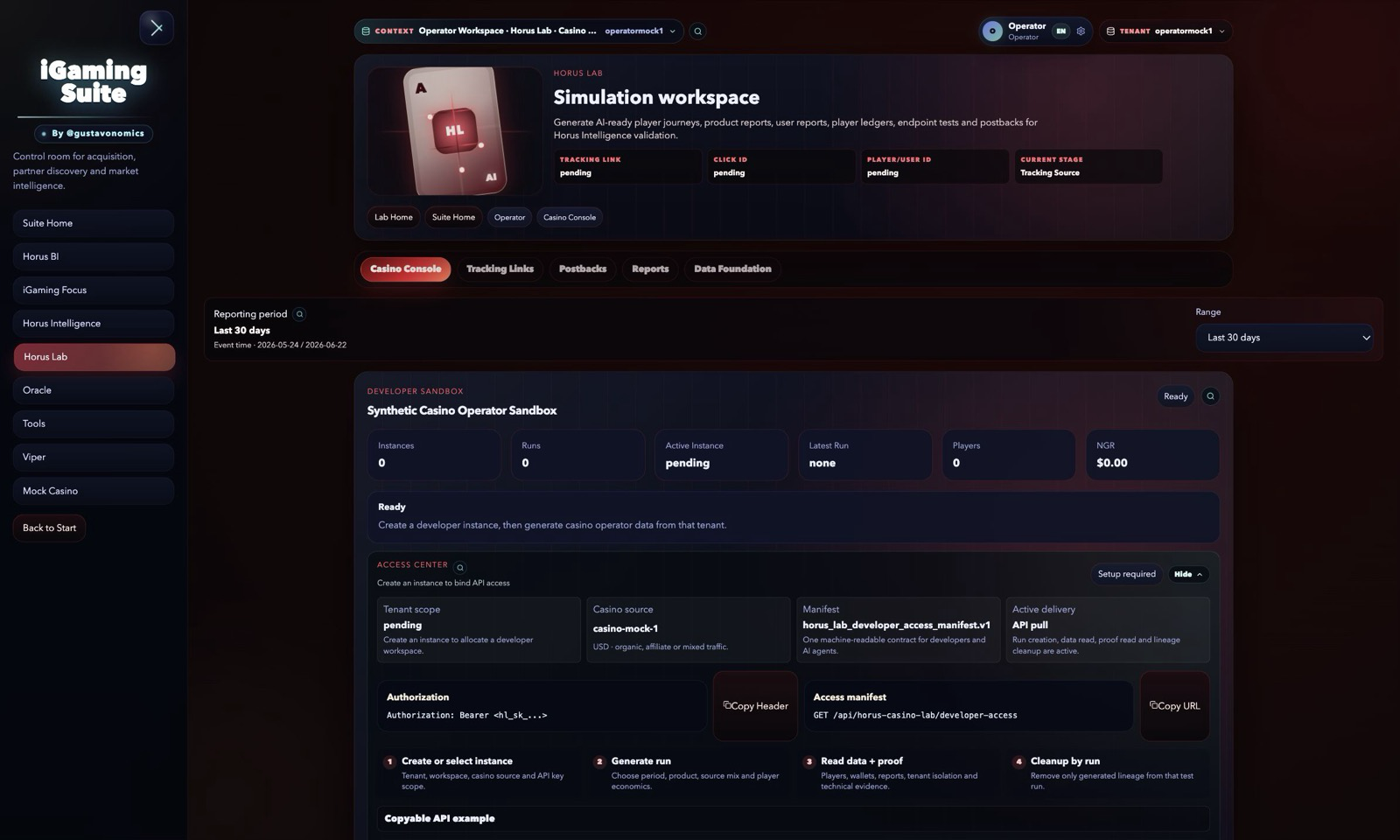
What synthetic casino data is
Synthetic casino data is real-shaped, non-real-player data that reproduces how an online casino actually behaves: players arriving from organic or affiliate sources, wallet movements, gameplay sessions, casino events and the reports an operator would run on top of them. It lets developers, BI teams and AI agents test integrations, reporting logic and CRM workflows without touching real player records. Generic synthetic-data tools can fake names and numbers, but they do not model casino source paths, wallet ledgers, gameplay economics, operator reports and run-level proof together, which is exactly what iGaming integrations need in order to test cause and effect.
- Real-shaped: player state, source path, wallet ledger, gameplay, casino events and report outputs are connected, not isolated columns.
- Safe: every row is non-real-player, labeled and isolated by run lineage.
- iGaming-specific: built around casino and operator workflows, not a generic table generator.
Method: model the workflow, not only the rows
The research program treats synthetic casino data as a workflow problem. A useful sandbox cannot stop at fake player names. It needs source-path context, wallet ledger rows, gameplay sessions, casino events, reporting aggregates, proof metadata and cleanup behavior so downstream systems can test cause and effect.
- Source path: organic or affiliate origin, tracking token and click context when applicable.
- Player state: synthetic identity, casino membership, account status and run lineage.
- Economics: deposits, withdrawals, wallet movements, gameplay outcomes and report-ready revenue fields.
- Proof: generated data, report totals, event lineage, limitations and cleanup confirmation by run ID.
How Horus Lab should be evaluated
The practical test is whether a developer or BI team can use one generated run to validate the same story through multiple surfaces: raw records, source-side casino reporting, affiliate reporting where attribution exists, and CRM/VIP experimentation where the synthetic data is explicitly labeled.
- Can a Products Report total be traced back to generated gameplay and wallet events?
- Can a Players Report row be traced to a run, source path and player-level event set?
- Can affiliate-attributed data stay separate from organic data until a valid attribution chain exists?
- Can a generated run be removed without deleting shared configuration or hand-created test accounts?
Limitations are part of the research value
The page should be explicit because that improves trust: synthetic data can validate contracts, demos, schemas, agent behavior and reconciliation logic, but it cannot prove live operator revenue, legal market status, real player psychology or real-money casino performance.
- Synthetic rows must be labeled and isolated by run lineage.
- Any public example must be non-real-player and safe to publish.
- Real operator integrations need reviewed CRM/casino adapters and consent-aware data contracts.
Product surfaces
These are the product names, modules and data objects used inside iGaming Suite today.
- players
- wallet_ledger
- gameplay_sessions
- casino_events
- products_report
- players_report
FAQ
What is synthetic casino data?
Synthetic casino data is real-shaped, non-real-player data used to test casino integrations, reporting logic, BI pipelines, CRM workflows and AI-agent behavior without exposing real player records.
What makes a casino dataset realistic enough for developers?
It should include connected player state, source paths, wallet ledger rows, gameplay sessions, casino events, report outputs, proof metadata and cleanup by run lineage.
Can synthetic data prove real casino performance?
No. It can validate contracts, schemas, workflows and demos. It cannot prove live operator revenue, real player behavior or regulated market performance.
Why does run cleanup matter?
Cleanup makes synthetic testing repeatable and safe by removing generated rows for a run without damaging shared configuration or authenticated workspace data.